Support vital abortion stigma busting efforts today!
DONATE
Climate and Reproductive Justice: Why Abortion Justice Cannot Be Separated from the Fight for Our Lands, Bodies, and Futures
Posted June 1, 2026 by the inroads teamOn April 1, 2026, as a part of #March 28 Global Day to Destigmatize Abortions, inroads convened a global conversation bringing together reproductive justice activists and organizers from Africa, Asia, Latin America, and SWANA (South West Asia and North Africa) to build a bridge between conversations that often happen in silos.
How does the climate crisis exacerbate stigma and barriers to reproductive healthcare?
Across the discussion, speakers reflected on how floods, displacement, militarization, environmental collapse, poverty, and political repression deepen barriers to abortion access and reproductive healthcare, especially for communities already pushed to the margins. Again and again, participants emphasized that our bodies cannot be separated from our territories, and that struggles for bodily autonomy are deeply connected to struggles for land, survival, dignity, and collective liberation.
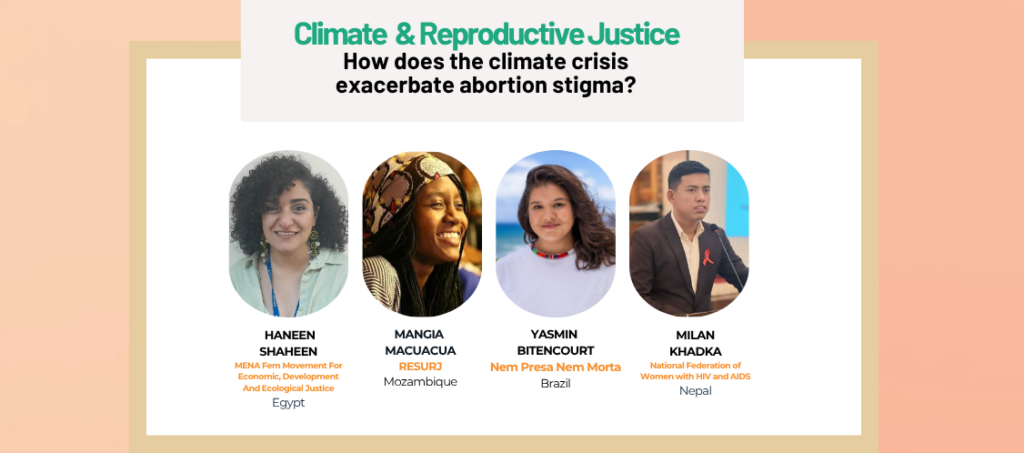
The session featured speakers from across the inroads network:
💚 Mangia from Mozambique, from RESURJ
💚 Yasmin from Brazil, from Nem Presa Nem Morta
💚 Haneen from Egypt, from Mena Fem
💚 Milan from Nepal, from the Federation of Women Living with HIV
Together, they shared grounded experiences from grassroots organizing in rural communities, urban peripheries, conflict zones, and territories deeply impacted by environmental injustice.
Insights & Calls to Action from Across Territories
Throughout the conversation, speakers shared urgent reflections and demands grounded in the realities their communities are facing. Again and again, they reminded participants that abortion justice cannot be separated from struggles for land, dignity, survival, healthcare, and collective liberation.
Haneen | Mena Fem, Egypt
Haneen spoke about the interconnected realities of militarization, genocide, forced migration, economic violence, and reproductive injustice across the SWANA region.
She called for an end to war and the militarization of women’s and girls’ bodies:
“Wars need to stop. Supporting the war needs to stop. Stop militarizing women and girls through these kinds of wars.”
Reflecting on the genocide in Gaza, she described how reproductive healthcare itself became a target of violence:
“During the genocide, during the peak of the genocide, in the limited aid that was entering Gaza, they were forbidding any reproductive health products to enter through any borders, and they were also starving people.”
Haneen urged participants to recognize how occupation, war, and environmental destruction shape reproductive realities:
“We need to stop the war on people, their lands and bodies.”
She also connected reproductive justice to debt, dictatorship, shrinking civic space, and international complicity:
“Release the economic tension that comes from the debt that our countries do have and push for wider civic space, which we cannot have without the support of the international community and civil society.”
Her intervention emphasized that authoritarianism and repression cannot be viewed as isolated national problems:
“We are in this together, and if we are approving a dictatorship somewhere, this dictatorship is going to be transmitted to another country sooner or later.”
And she reminded participants that solidarity must move beyond borders and distance:
“Just because we are a little bit far away from each other, we should know that what I am facing is similar to what another woman on another continent is facing.”
Haneen also stressed that abortion justice movements must hold the diversity and complexity of people’s realities, especially in contexts where basic protections do not exist:
“It’s very important to understand that women’s requests are very different based on their economic status, political status and where they are.”
Speaking about Egypt specifically, she reflected:
“When we are talking about abortion rights, for example in Egypt, where no law exists to protect from marital rape, it is crucial to include all our narratives when we are defending women’s reproductive health.”
She closed with a collective call:
“We must come together and fight.”
Mangia | RESURJ, Mozambique
Mangia reflected on how climate disasters intensify already existing barriers to abortion access and healthcare in Mozambique and across the region.
She described how abortion access is already shaped by corruption, bureaucracy, and legal restrictions even before crises occur:
“When we talk about climate justice, climate crisis, and we connect this to access legal abortion, or all the health service abortions, which is difficult and corrupt and bureaucratic in everyday circumstances too.”
And during emergencies, she explained, these barriers become even more severe:
“Even more in crisis, our governments never prioritize sexual and reproductive health.”
Mangia challenged the logic that treats reproductive healthcare as less urgent than other emergency needs:
“Governments always prioritise other demands like food and accommodation as superior in importance to SRHR.”
She asked participants directly:
“Why can they not go hand-in-hand?”
Her reflections also highlighted how women and girls face heightened violence and exploitation during climate disasters:
“We need to stop the sexual harassment and violence that happens in times of climate disasters.”
She specifically pointed to abuses happening within aid and government systems themselves:
“At local levels especially, government bureaucracies are abusing women in need.”
Mangia also emphasized the impact of global funding cuts on abortion access and reproductive healthcare systems:
“While huge funds are mobilised and released during climate disasters, the allocation of funds needs to be checked.”
Referencing recent aid cuts, she warned:
“Global cuts, such as the recent USAID cuts, impact abortion access at local levels.”
Her intervention ended with a demand that SRHR be treated as fundamental within all development and humanitarian responses:
“When development and development aid is being discussed, integral SRHR should be a key component.”
Milan | Federation of Women Living with HIV, Nepal
Milan shared reflections from rural and mountainous territories in Nepal, centering the realities of women living with HIV facing climate vulnerability, isolation, and overlapping forms of stigma.
He called for HIV-sensitive and gender-sensitive responses during climate emergencies:
“We need training and integration of HIV-sensitive and gender-sensitive responses to crises.”
Milan emphasized the importance of maintaining uninterrupted healthcare systems during disasters:
“We need pathways to support uninterrupted services like ART, PMTCT and other healthcare support.”
He also highlighted the importance of food security and housing stability for women living with HIV during climate crises:
“Build pathways for resilient food and accommodation to handle climate crises, as the immunity and health of people living with HIV should not be compromised.”
His intervention explored how stigma compounds itself across multiple systems of oppression:
“Practices like child marriage and chaupadi are rooted in stigma.”
And he reflected on the multiple layers of discrimination women living with HIV face:
“Women living with HIV also face stigma around their status, as well as abortion stigma.”
Milan called for climate and reproductive justice leadership to shift away from urban centers and toward the communities most impacted:
“Move decision-making from the urban centers to places most directly facing climate vulnerability.”
He specifically emphasized the importance of centering women and gender-diverse people from mountainous and rural communities in decision-making processes.
Yasmin | Nem Presa Nem Morta, Brazil
Yasmin grounded her reflections in Black feminist and Indigenous understandings of territory, spirituality, and collective survival.
She referenced the work of Maya Xinka feminist Lorena Cabnal and the idea that body and territory cannot be separated:
“Our bodies are inseparable from our territories.”
She described how Indigenous feminists across Latin America have guided movements toward “a more spiritual and ancestral perspective around climate justice.”
Yasmin also spoke about environmental racism and the unequal impacts of climate collapse and abortion stigma in Brazil:
“Most of the effects of climate change and abortion stigma are most intense for Black, poor, racialised people and people of gender diversities, especially trans people in Brazil.”
She stressed the need to center these communities politically:
“We must center their voices and perspectives.”
Her intervention connected reproductive injustice directly to extractivism, neoliberalism, and territorial exploitation:
“When the territory is controlled and collapses, reproductive rights also collapse.”
She called for stronger connections between abortion justice and movements rooted in land defense and collective care:
“We must interweave with agroecology, buen vivir and other such movements to strengthen our collective power.”
Yasmin also warned about the role anti-rights groups play during crises:
“We need to fight narratives created by anti-rights groups, especially in crises where they try to fraudulently mobilise funds.”
And she emphasized the need to amplify the leadership and realities of those most directly impacted by abortion stigma:
“We must amplify narratives and perspectives of those facing abortion stigma directly.”
She closed by insisting on the importance of listening to adolescent girls, women, and trans people as political actors and movement leaders.
We Who Believe in Freedom…
The session closed with a collective poem written live by speakers and audience members through the chat, reflecting shared grief, rage, solidarity, refusal, and hope.
In times of increased militarism and oppression
In times of online surveillance
In times of hate and regressiveness
In times of rising conservatism
In times of acute crisis and threats to bodily autonomy
In times of systematic erasure of colored FLINTA bodies
In times of grief, militarisation, darkness
In times of state repression
In times of crisis
We, who believe in freedom, stand together fighting for justice
We, who believe in freedom, accompany abortions
We, who believe in freedom, remember all those who came before us and resisted
We, who believe in freedom, need meaningful collaboration to foster collective action
We, who believe in freedom, protect each other
We, who believe in freedom, need to heal from our different traumas
We, who believe in freedom, write, document and archive
We, who believe in freedom, do not wait for our government and lawmakers to catch up with our realities and organize ourselves with mutual aid
We, who believe in freedom, are rooted in solidarity
We, who believe in freedom, will find ways to keep each other safe
——-
This session was hosted as part of the global agenda connected to March 28, the Global Day to Destigmatize Abortions.
Learn more here.