Support vital abortion stigma busting efforts today!
DONATE
Resourcing reproductive justice futures in a time of constraint
Posted July 6, 2026 by the inroads teamAcross reproductive justice movements, there is growing recognition that the current moment cannot be understood only as a funding crisis.
Movements are navigating shrinking funding pools, increasing political hostility, digital censorship, criminalization, funder caution and withdrawals, and expanding anti-rights coordination.
Organizations are being asked to sustain urgent work while adapting to rapidly changing political conditions and funding restrictions. In many spaces, competition for survival is quietly reshaping relationships that have long depended on collaboration and solidarity.
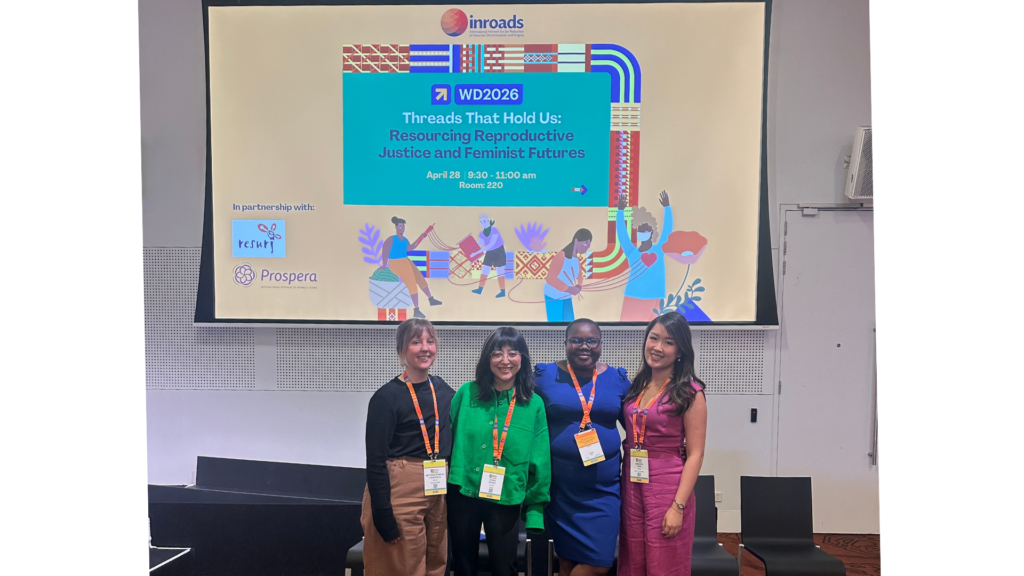
These realities formed the backdrop of a session titled “The Threads that Hold Us: Resourcing Reproductive Justice and Feminist Futures” at the recent Women Deliver 2026 conference in Naarm (Melbourne), Australia led by inroads (The International Network for the Reduction of Abortion Discrimination and Stigma) along with Prospera International Network of Women’s and Feminist Funds and Realizing Sexual and Reproductive Justice (RESURJ).
inroads organised this space to hold reflections from the past few years on the impact of funding cuts across the ecosystem and the ongoing financial pressures, but also with the wisdom and creativity as a movement-accountable network and intermediary that has built pathways beyond abortion restrictions, bans, and stigma.
The session was designed as a fishbowl dialogue centered around three questions:
- – How are we defining the current feminist resourcing landscape?
- – What already exists within movements that continue to sustain us?
- – What are we experimenting with to create more abundance during a time of restrictions?
What emerged was a shared recognition that reproductive justice movements are navigating multiple layers of instability at once. Funding itself is shrinking, while the channels that allow resources to move safely and sustainably are becoming increasingly fragile and restrictive.
Working on a highly stigmatized area, even in “feminist” philanthropy, inroads members are navigating compounding challenges: exclusion and silencing of abortion-related work and lived realities, skewed metrics, siloes, binary thinking, and more.
As moving resources across borders grows more complex, our movements are also facing increasing risks when relying heavily on infrastructure based in the Global North. At the same time, anti-rights actors have continued building, infiltrating and organising coordinated ecosystems across political lobbies, legal advocacy, digital platforms, and community spaces.
Audience members from Australia, Kenya, and Uganda shared their direct experiences countering increasingly coordinated anti-rights attacks within their local contexts.
As Bethan Cansfield, Interim Director of Communications and Advocacy from Prospera International Network of Women’s and Feminist Funds offered:
“With the [withdrawal] of just four large funders, about USD 754 million has gone from our movements … This is happening at a time when funding to anti-rights actors is increasing, to the tune of about USD 1.8 billion between 2019 and 2021.”
The conversation moved beyond funding alone, toward questions of infrastructure, sustainability, and power.
Dana Zhang from RESURJ reflected on the collective’s work in examining infrastructures for moving money, including fiscal sponsorship, and how those systems shape risk, access, and visibility within movements:
“Maybe it’s not about finding a better version of the same model. Can we think of different structures that allow us to work collectively, that then allow us to hold our resources in a different way? This experiment actually allows us to ask a different kind of question, such as what infrastructure can look like if we are not trying to reproduce the same institutional logic we often struggle with.”
The dialogue returned repeatedly to an equally important question:
What continues to sustain movements under these increasingly restricted conditions?
The conversation created space to name the difficult tensions that many organizations are carrying, including self-censorship, funder pressure, compromises around fundability, and the challenge of sustaining solidarity while competing for limited resources.
Again and again, dialogue participants grounded the conversation in relationships, mutual aid, political commitment, and collective care. Audience members spoke about supporting activists facing arrest or legal threats, convening communities with minimal to no resources, mentoring emerging organizations, co-financing gatherings, and experimenting with more horizontal ways of working together.
As Dana shared:
“So many of us didn’t start our activism with big institutions or through a lot of funding. We started our activism because of people, because of love, because of trust, because of relationships, friendships, political commitment, because we care. … All [of] those things are actually resources – resources that cannot be purchased by money.”
For many participants, “abundance” was understood less as financial certainty, and more as the collective capacity to continue moving together, even under pressure. Through the participatory fishbowl dialogue format, the room held deep recognition of what this means in practice:
- – Supporting organizations before they become institutionally legible
- – Funding labor and care work
- – Resourcing experimentation
- – Taking political risks on emerging movements
- – Creating conditions where grassroots organizations can grow sustainably rather than remain trapped in precarity
Participants also reflected on the experiments that movements are already working on, in response to this moment. How do we continue building collective abundance under conditions designed to fragment us?
Christine Wambua, Co-Lead and Finance Director from inroads, shared:
“[Even when funding restrictions occurred], at inroads, we continued creating spaces and resources for members to come together and learn from each other, exchanging knowledge in our community workspace and abortion stigma online course, partnering to make possible a SWANA gathering, coordinating collective iniatiatives, and finding creative ways to organize with and for our community.”
These conversations reflect how inroads has adapted its work in creative ways under limited resources and facing severe funding constraints, to continue to hold a global home for abortion freedom movements, and across the reproductive justice ecosystem. At a time when many movements are navigating exhaustion, fragmentation, and political uncertainty, creating spaces for accompaniment, political reflection, and shared learning, despite increasing restrictions, becomes more important than ever.
What emerged throughout the session was a shared understanding that reproductive justice movements cannot respond to anti-rights coordination in isolation.
This moment requires stronger movement infrastructure, deeper cross-regional collaboration, intergenerational learning, collective protection strategies, and funding models rooted in trust rather than extraction.
By the end of the session, a collective thread held the speakers and participants together: Abundance is not something that movements can wait to receive once conditions improve.
Instead, as we witnessed and heard in the room, abundance is something that movements are already practicing through collaboration, experimentation, trust, political commitment, and collective care.
In a time shaped by restriction and uncertainty, that collective practice of creating abundance together remains one of the most important forms of reproductive justice infrastructure that we have.